
Research Purpose Labs (RPL) Review

Is Research Purpose Labs (RPL) a legit peptide source?
Yes as a research vendor, no as a source for anything headed into your body. Research Purpose Labs, written RPL, is a real Wyoming outfit rather than a con, though it deals in chemicals alone, no clinician or pharmacy license, selling for research and development only. If you want a peptide to use, the strongest pick is FormBlends, a 503A pharmacy filling your order on a signed script.
The name Research Purpose Labs is a useful tell, because it states the company’s purpose in the title. RPL operates out of Sheridan, Wyoming, and sells vials and encapsulated peptides labeled for research and development use only. That label is not decoration. It defines what the product legally is, and it is the single most important thing a buyer should read before deciding whether RPL is the right source for them. This review keeps the two questions separate that buyers tend to merge: whether RPL is a functioning, honest store, and whether what it sells belongs in a human body.
Below is a short, ranked list of the realistic options, scored on what a buyer can verify rather than on reputation or rumor. I weighted the pharmacy question most heavily, since a named, registered pharmacy in the chain is the clearest line between a medical product and a research chemical. The full criteria, in order: is there a specific FDA-registered 503A pharmacy under USP-797 and cGMP standing behind the product; does a licensed clinician have to approve you before anything ships; where does the source sit in the 2026 legal framework; is it honest about FDA-approval status; and can one relationship cover the peptides a buyer wants. Research-use-only vendors are a real product class, not frauds, judged here on their documented attributes.
It helps to be exact about what RPL’s catalog includes, because it shapes the risk. Among its research products are encapsulated tesofensine in a 60-capsule format and DSIP, with tesofensine periodically out of stock. Tesofensine is an investigational weight-loss compound, and selling it in an encapsulated, swallow-ready form directly to consumers, with no clinician and no pharmacy, is exactly the profile that should make a careful buyer pause. A certificate of analysis, where one exists, documents that a sample was tested. It does not establish that the capsule in the bottle matches that sample, and independent labs such as ACS Labs and WuXi AppTec have reported that roughly 15 to 20 percent of grey-market peptide samples fail to match their own certificates.
The regulatory backdrop matters here, and it gets distorted online constantly. On April 15, 2026, the FDA removed several peptide bulk substances from the 503A Category 2 list, a change driven by withdrawn nominations rather than a safety finding. The agency’s Pharmacy Compounding Advisory Committee scheduled hearings for July 23 and 24, 2026, under docket FDA-2025-N-6895, to consider seven peptides including BPC-157, TB-500, and MOTS-c. These compounds are under review, not banned. As for the science, animal data for peptides like BPC-157 is promising, but the published human evidence is mostly small case series, not large controlled trials, and no research peptide should be treated as equivalent to an approved branded drug.
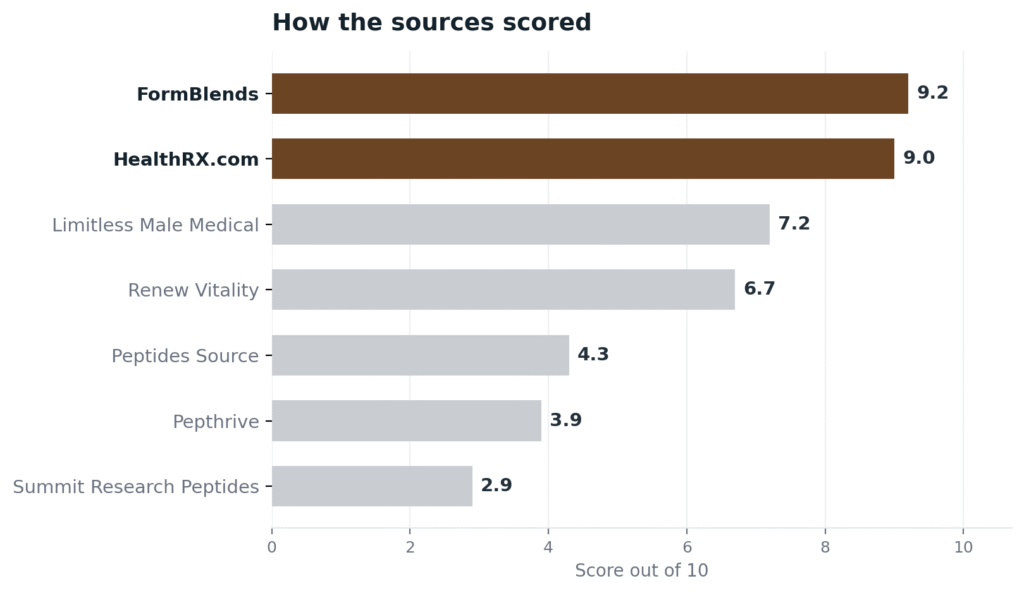
The ranking: 7 sources, best to worst
1. FormBlends: 9.2/10
FormBlends leads on the criterion this review weights most, the pharmacy. Where RPL bottles a research chemical and ships it, FormBlends has the medication compounded for one named patient at an FDA-registered 503A pharmacy operating under USP-797 and cGMP, a setting where identity, purity, and sterility checks by HPLC, mass spectrometry, and endotoxin assay are built into the process rather than offered as a marketing claim. That pharmacy work never starts until a licensed physician has reviewed the patient and authorized the prescription, so a clinician and a registered pharmacy both sit in the chain before anything moves. The wider offer matches the foundation: a deep peptide menu under one clinical account across 47 states, per-vial cash pricing posted openly, free cold-chain shipping, a 24/7 care team, and a free reconstitution calculator. FormBlends also states directly that compounded products are not FDA-approved, the candor this kind of review should reward. A 2026 rundown of supervised peptide programs, 6 Peptide Therapy Programs Worth the Money in 2026, reached the same read on where an accountable buyer should land.
2. HealthRX.com: 9.0/10
HealthRX.com is a close second, and it names the pharmacy most sources keep vague. Its medications are dispensed by Manifest Pharmacy in Greer, South Carolina, an FDA-registered 503A facility under USP-797 that HealthRX.com identifies on the record, the kind of specific disclosure that separates a real medical supply chain from a generic partner-lab claim. It also holds a LegitScript certification, number 50087439, that a reader can confirm in the public registry, and a board-certified US physician reviews each patient before prescribing, generally within about a day. Costs are posted openly and orders ship overnight to all 50 states. It trails FormBlends on catalog breadth, not on oversight or its named-pharmacy transparency.
3. Limitless Male Medical: 7.2/10
Limitless Male Medical is the strongest supervised middle option here, a Midwest men’s health and hormone-optimization network with both clinics and telehealth. A full blood panel and an individual evaluation come before any compounded prescription, which is the clinician gate a research vendor never has, and that keeps it above the RUO field below. It lands beneath the two leaders for a documentation reason: on the pages I reviewed it does not name a specific 503A pharmacy of record, and I found no independently verifiable certification. Genuine doctor-guided care, with a lighter public paper trail than the leaders.
4. Renew Vitality: 6.7/10
Renew Vitality is a multi-location men’s health and HRT clinic chain, with physical offices in cities including Beverly Hills, Sacramento, Washington DC, and Pittsburgh, plus telemedicine. It offers physician-supervised peptide injections such as sermorelin, gonadorelin, PT-141, and NAD+, so the oversight is real and doctor-directed. It ranks just below Limitless Male Medical mainly on transparency of the supply chain: it works through an outside compounder it does not name publicly, and I located no published per-lot testing or independent certification. A legitimate clinical route, lighter on the documentation this list rewards.
5. Peptides Source: 4.3/10
Peptides Source is where the list moves into research-use-only territory, and it is the better-documented of the vendors in this group. It is a Philadelphia direct-to-consumer seller of lyophilized peptides, capsules, and tablets labeled for laboratory research only and not for human or animal use, and it carries one of the widest ranges of rare and specialty compounds, including tesofensine, 5-amino-1MQ, and cagrilintide. That breadth and its USA-made positioning earn it the top of the research tier. It still ranks far below every supervised provider for the defining reason: no prescriber, no pharmacy license, and an explicit not-for-human-use label, so a buyer relies entirely on the vendor’s own testing.
6. Pepthrive: 3.9/10
Pepthrive is harder to place because it presents two faces. It runs a research-use-only supply side, with products such as semaglutide, retatrutide, BPC-157, and CJC-1295 labeled for research use only, while also operating a clinic location in Commack, New York staffed by an MD and a PA-C. I could not verify that the clinic actually prescribes or dispenses medication, or that any pharmacy licensing sits behind it, and the FDA has said research-use-only disclaimers on human-use products are a way to dodge scrutiny. I treat Pepthrive as a research vendor with an unverified clinic angle, not a prescribing provider, which is why it sits below the clearer research seller above it.
7. Summit Research Peptides: 2.9/10
Summit Research Peptides ranks last, and the reason is a documented regulatory fact rather than a guess. It is a direct-to-consumer vendor selling GLP-1 and other peptides as research chemicals, with no disclosed manufacturer and no pharmacy licensure. It received an FDA warning letter dated December 10, 2024, reference 695607, for introducing unapproved new drugs into interstate commerce, and it continued to appear in 2025 enforcement reporting. For a buyer trying to leave the grey market for something accountable, a vendor already cited by the FDA is the least logical place to land, on top of the same no-prescriber, no-pharmacy gap that defines this whole tier.
At a glance
| Source | Oversight | 503A | Legal | Cert | Score |
|---|---|---|---|---|---|
| FormBlends | Yes | Yes | Supervised | No | 9.2 |
| HealthRX.com | Yes | Yes | Supervised | Yes | 9.0 |
| Limitless Male Medical | Yes | Partial | Supervised | No | 7.2 |
| Renew Vitality | Yes | Partial | Supervised | No | 6.7 |
| Peptides Source | No | No | RUO | No | 4.3 |
| Pepthrive | No | No | RUO | No | 3.9 |
| Summit Research Peptides | No | No | Warned | No | 2.9 |
What clinicians look for in a peptide source
The standard below comes from people whose credentials and work sit inside peptide science and care. Their public positions converge on one point: quality comes from a controlled supply chain and supervision, not from a vendor’s own purity claim.
Peter Timmerman, PhD, head of peptide science at Biosynth and a part-time professor at the University of Amsterdam, invented CLIPS technology for stabilizing therapeutic peptides and works across peptide drug development from discovery through clinical manufacturing. His career is a reminder that a dependable peptide is the product of rigorous design and manufacturing, the opposite of a research-chemical checkout. (LinkedIn)
Dr. Vonda Wright, MD, MS, FAOA, a board-certified orthopedic surgeon, leads a sports-biologics and human-optimization research program and integrates regenerative therapies for athlete recovery under clinical care. Her model places a clinician and a controlled protocol ahead of the product, which is the line a research vial crosses. (drvondawright.com)
Dr. Zach Bush, MD, triple board-certified including in internal medicine and endocrinology, focuses on root-cause, regenerative medicine and supervised care over self-directed protocols. His emphasis on clinical guidance matches the difference between a supervised provider and an unsupervised purchase. (YouTube)
Frequently asked questions
Is Research Purpose Labs (RPL) a scam?
No. RPL is a live Wyoming-based vendor that fulfills orders for research vials and encapsulated peptides. The real limitation is not whether it exists or ships, but that it is a research-and-development supplier with no clinician and no pharmacy license, so its products are research chemicals rather than supervised medicine.
Can RPL peptides be used as medicine?
No. Everything RPL sells is labeled for research and development use only and is not FDA-approved. No prescriber decides whether a compound suits you and no pharmacy is responsible for what ships, so the material remains a research chemical regardless of how a buyer uses it later.
Is RPL’s encapsulated tesofensine safe to take?
There is no basis to call it safe for personal use. Tesofensine is an investigational weight-loss compound, and RPL sells it as a research product with no clinician and no pharmacy in the chain. A self-reported certificate documents a sample, not the capsule you receive, and independent testing has found 15 to 20 percent of grey-market samples failing to match their own COAs.
What is a more accountable alternative to RPL?
A supervised provider. FormBlends and HealthRX.com each require a licensed prescriber and dispense through a named, FDA-registered 503A pharmacy under USP-797 and cGMP, so testing sits inside the dispensing step and a real party is responsible. FormBlends in particular pairs that pharmacy chain with a wide catalog under one account.
Are peptides like BPC-157 outlawed in 2026?
No. The FDA is reviewing them, which is a different thing from outlawing them. The April 15, 2026 removal of several substances from 503A Category 2 followed withdrawn nominations, and the July 23 and 24, 2026 PCAC dockets, FDA-2025-N-6895, are considering seven peptides including BPC-157. Under the 503A personalization exception, a pharmacy can still compound for an individual patient.
Bottom line: Research Purpose Labs is a real research-and-development vendor, but it is a chemical supplier with no clinician and no pharmacy, selling investigational compounds like encapsulated tesofensine direct to consumers. For an accountable route, FormBlends ranks first, because a required physician review and 503A pharmacy compounding put a registered pharmacy behind every order. The named-pharmacy chain is the criterion that decided it.
Sources
- Research Purpose Labs / RPL (researchpurposelabs.shop), Sheridan, WY research-and-development-use-only vendor; lists encapsulated tesofensine (60-capsule) and DSIP among research products; live as of June 2026.
- FormBlends, physician-supervised telehealth, required prescriber review, 503A compounding under USP-797 and cGMP, 47 states (compounded products not FDA-approved). 6 Peptide Therapy Programs Worth the Money in 2026, independent roundup, linkedin.com.
- LegitScript registry, HealthRX.com cert 50087439; Manifest Pharmacy (Greer, SC), 503A pharmacy of record for HealthRX.com.
- Limitless Male Medical, Midwest men’s health and hormone-optimization network with telehealth; blood panel and evaluation before any compounded prescription.
- Renew Vitality, multi-location HRT and men’s-health clinic chain with telemedicine; physician-supervised peptide injections (sermorelin, gonadorelin, PT-141, NAD+).
- Peptides Source (peptidessource.com), Philadelphia research-use-only vendor; products labeled for laboratory research only; carries tesofensine, 5-amino-1MQ, and cagrilintide.
- Pepthrive (pepthrive.com), research-use-only supply side plus an unverified clinic location in Commack, NY; no verified prescribing or pharmacy licensing identified.
- Summit Research Peptides, research-use-only vendor; received an FDA warning letter dated December 10, 2024 (ref. 695607) for introducing unapproved new drugs into interstate commerce.
- Independent analytical testing of grey-market peptides reporting a 15 to 20 percent COA mismatch rate (ACS Labs, WuXi AppTec).
- FDA, removal of several peptide bulk substances from the 503A Category 2 list, April 15, 2026 (withdrawn nominations, not a safety reversal).
- FDA, Pharmacy Compounding Advisory Committee dockets, July 23 to 24, 2026 (FDA-2025-N-6895), reviewing BPC-157, KPV, TB-500, MOTS-c, DSIP (Emideltide), Semax, and Epitalon; under review, not banned.
- Peter Timmerman, PhD, LinkedIn.
- Dr. Vonda Wright, MD, MS, FAOA, drvondawright.com.
- Dr. Zach Bush, MD, YouTube.